



No lions, no tigers, but we do have bears: Animal control officer provides safety tips
by Mark Jahne
Editor
It’s one thing to look out the window and see a skunk, possum or raccoon in the yard. It’s something else altogether if you see a 300-pound black bear.
The Farmington Valley towns and West Hartford have been the hotbed of bear activity for many years. People who live there have grown accustomed to their presence.
These giants of the forest are slowly expanding their range. While sightings in this town are infrequent, they do live among us now, and it’s important to know what to do if you encounter one in a neighborhood, park or other setting.

Amanda Mastroberti is the animal control officer at the Wethersfield Police Department. She handles all kinds of animal complaints ranging from stray dogs to a wide assortment of wildlife.
“I started here in July 2025. I was an ACO previously in Nashville,” she said. She described the difference between working in a large Southern city and a New England suburb as “a lot of big changes.”
Mastroberti receives calls about bears every day. But that doesn’t mean an invasion is taking place. “Everybody calls” when they see a bear in their neighborhood, she said.

Her best estimation is that there are no more than three bears that have taken up residence in town. She knows this because she responds to these calls and the bears all have numbered ear tags applied by state conservation officers. The numbers are always the same. One of them also wears a GPS tracking collar.
“I have heard several reports of cubs,” she added.
They are usually spotted doing what bears do in a residential or business area – going through the garbage for food scraps and eating the contents of bird feeders. She advises residents to take feeders down during the summer to keep bears away. The birds have plenty of natural food available.
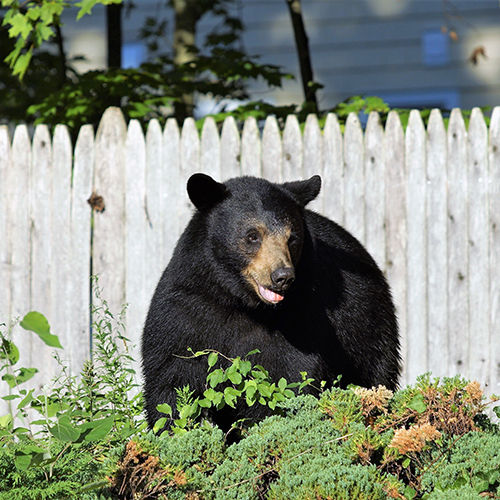
“They’re very curious animals. They’re so intelligent,” she said of these large woodland creatures.
She has seen one playing with a backyard swing set. Bears will always seek the easiest route to a food source.
“We have to learn to co-exist with them. We as humans have taken over a lot of land over the years” and bears are among the animals that struggle with loss of habitat. “They are not confrontational animals to begin with,” Mastroberti said.
She strongly advises people to keep their distance and not to run if they see a bear because this will trigger the animal’s instinct to chase.

If a bear is deemed dangerous, the police department will contact the state Department of Energy and Environmental Protection. Its conservation officers will shoot it with a tranquilizer dart and move it to a safer area.
“We get [bear] calls in Mill Woods all the time” as well as from the Wethersfield Country Club, she said.
Her latest challenge is rats living around Folly Brook that were disturbed by the demolition of the former nursing home on Jordan Lane that is being redeveloped into an apartment complex.
The following information is from BearWise, an organization that helps people to live safely and responsibly with black bears. This species averages 300 pounds in weight; males tend to be bigger.
Never feed or approach bears. They will defend themselves if you get too close for comfort. A mother bear protecting her cubs can become extremely aggressive.
Bears are curious and have a powerful sense of smell. They will follow anything with an odor and investigate anything that they have learned can yield a food reward such as garbage, bird seed, pet food, beehives and more.
The best way to keep bears away is to make sure there are not any food sources on your property that will attract them. Once they find a food source, they are likely to return.
They are attracted to the burned fat and scraps of meat on barbecue grills. People are advised to thoroughly clean grills and smokers after each use and keep them covered.
To keep bears aware from the trash make sure the cans are cleaned often to reduce odors and that recyclables are rinsed and cleaned. Put garbage cans out the morning of collection, not the night before. Food should not be left in cars or trucks that are parked outdoors.
Do not feed the birds when bears are active in the area. Birds have plenty of natural food available and bears will devour the contents of bird feeders and probably destroy them in the process.
Do not store bird feed inside screened porches or in sheds. Bears will tear the screens and break windows to access this seed. Pets should only be fed indoors and food should not be placed outside for wild or stray animals or outdoor pets.
If you have fruit trees, pick the produce daily and remove any fallen fruit from the ground. Do not use fertilizers that contain blood meal or bone meal. Do not place meat, bones, fish, oil, grease, dairy products, eggshells or fruit in a compost unit.
There are certain outdoor features that are difficult to remove and that bears find attractive. These include nearby woods and dense bushes, trees and plants that produce berries and acorns, and water sources such as swimming pools, hot tubs, streams and other landscape water features.
Keep the garage door closed. Do not leave coolers with food and drinks on porches, patios, decks or in the car. Barricade crawl spaces and other areas under the house prior to hibernation season. Screen doors and window screens will not deter bears if they are following a food aroma.
It is also advised to alert your neighbors to any bear activity.
Pet owners need to know that bears and dogs do not get along. According to BearWise, more than half of the incidents involving people and black bears between 2010-2015 involved dogs. Forty-six percent of those dogs were killed or injured and 62 percent of the people were injured.
In many cases, the dogs were off leash and chased and/or cornered the bear. Those that were not killed or injured ran back to their human partner with an angry bear in pursuit.
Back bears evolved in forested habitats where they learned to respond to danger by climbing a tree or disappearing into the woods. When those options are not available, their instinct for self-preservation will lead them to defend themselves and their food sources.
A dog that interrupts a bear’s meal is putting itself in danger. A person who comes between the dog and the bear is risking his or her life.
BearWise also offers the following advice on how to safely haze a bear to make it leave and give you time to remove or secure any food items that are attracting it. The latter is important because if there is nothing to attract a bear it will move on and is less likely to return.
• Never approach, corner or chase a bear.
• Stand in a safe place. Bring children and dogs inside.
• Be sure the bear has an escape route away from you.
• Stop hazing when the bear escapes or climbs a tree.
• If the bear approaches, do not run. Use bear spray repellant.
• Understand that hazing a bear is done at your own risk.
People can scare away bears by asserting dominance such as making eye contact and waving arms above the head to give a sense of being big. Noise is a powerful deterrent: yell, blow a whistle, car horn, air horn, clap your hands, bang pots and pans. Another option is to have motion-activated lights, alarms and water sprinklers.
Bears should be scared away when they are eating garbage, bird seed or pet food, near a vehicle, building, garden or campground. Do not haze a bear if it would chase the animal into the street or toward other people and animals.
Leave bears alone if they are in a natural area where they belong. Do not haze bear cubs because this will agitate the mother.
Call police animal control or another wildlife agency if the bear is highly agitated, sick, injured, approaching people or not responding to hazing.
The website wildlifehelp.org points out that wildlife agencies only euthanize bears that pose a serious threat to public safety. People are advised to call a local wildlife expert, such as police animal control, with any questions or complaints related to a specific bear and report any injuries to humans, pets or livestock.
If a person or pet is scratched or bitten by a bear a doctor or veterinarian should be called immediately. WL
If you see a bear in your neighborhood call the police department routine phone line at 860-721-2900. The dispatcher will pass along your information to an animal control officer and/or patrol officer.