


Rosetown Review - Independence at last
By Richard Franklin Donohue
Town Historian
Photos - Submitted
“The citizens of Cromwell manifested their delight on Wednesday evening upon attaining the dignity of a free and independent township, by the firing of guns, burning of tar-barrels and sundry other demonstrations usual upon such occasion.”
–Hartford Courant, June 23, 1851
In 1788, the allure of independence that had driven the formation of the United States 12 years prior was still alive and well in the outlying villages of Middletown, Conn. Late in the year Jared Shepherd, Ely Butler and William White, all Middletown Upper Houses veterans of either the War for Independence or the French & Indian War, met with like-minded residents of Middlefield and Westfield to discuss separation from the greater town of Middletown.
The group presented a petition to the town meeting in December “praying for the liberty to be made a new town.” For the next three months a committee explored the idea but the proposal was ultimately voted down at a town meeting in March.
While the specific grievances of the would-be separatists are not clear, a likely motivating factor – at least for the people of the Upper Houses – was the independent prosperity that had developed after the American Revolution. Maritime trade along the East Coast and with the East Indies had encouraged an active riverport that grew exponentially until the embargoes associated with the War of 1812 all but obliterated it.
In the decades that followed, the community returned to its agricultural roots until the 1840s, when its economy expanded with the advent of brownstone quarries and prosperous industrial concerns. By 1848, a new generation of influential citizens was ready to try once again to create an independent town north of the “riverette.”

On April 24, 1848, Lorenzo Treat led a meeting of nine Upper Middletown men in discussing the formation a new town. Instead of bringing their wishes to a town meeting, as was done 60 years prior, the gathering resolved this time to send a direct petition to state government.
Treat, along with George R. Kelsey and Rufus B. Sage, set to work drafting this “memorial to the Legislature” while others were assigned to a committee charged with notifying the town of Middletown of their intentions.
Meeting again in May, the separatists realized that “there was not sufficient time to carry out [their] plans at the coming session of the Legislature” and decided to wait in order to “examine into the facts regarding all matters which may tend to forward the object of this meeting, such as taxes, school abatements, city grievances in general and town matters in particular.”
The meeting was adjourned until September, but the group did not actually convene again until the following February, at which point all present voted to organize their grievances into a final petition to the state legislature. For reasons that are unclear, no further action was taken for nearly two years.

Finally, on March 10, 1851, a notice appeared on the signpost in the village center requesting that “the citizens of Upper Middletown meet at the academy on Wednesday the 12th at 2 o’clock p.m. for the purpose of considering the expediency of petitioning the next Legislature for a separation of Upper Middletown from the town of Middletown.”
The committee had now grown to 22 members who were more determined than ever that separation take place as soon as possible. On the motion of Abial Gear, a committee headed by Selden Ely was appointed to draft the petition and have it ready in one week.
The following Tuesday, Ely’s committee introduced a petition from the “thirteen hundred … inhabitants and electors of that part of Middletown … known as the North Society, or Upper Middletown” entreating the General Assembly to constitute and organize the village as a distinct town.

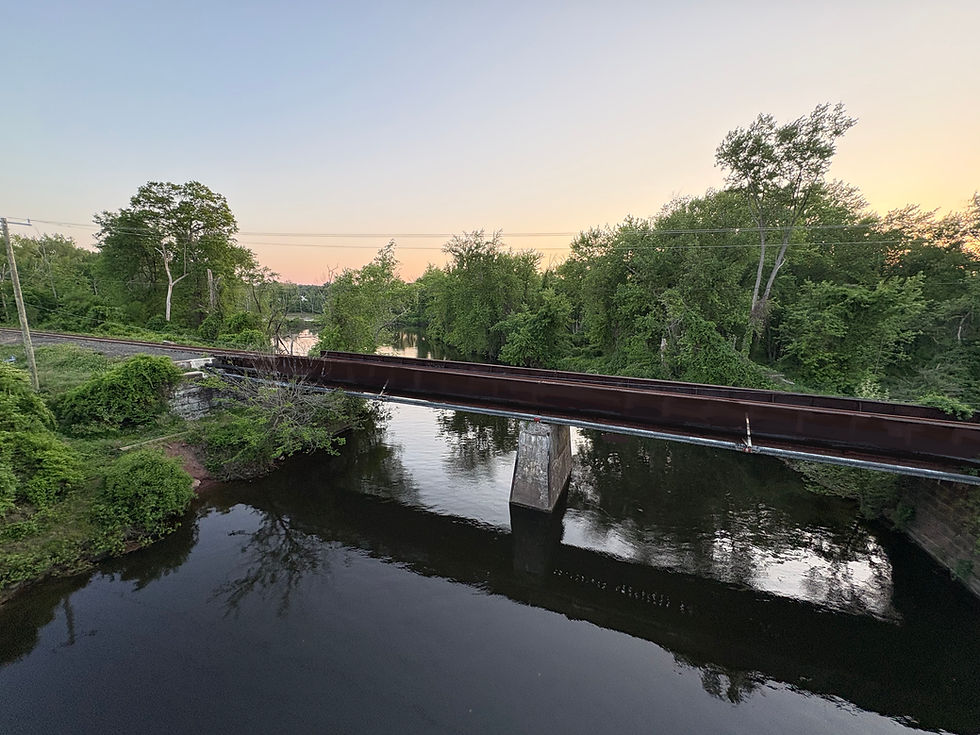
To support the request, the committee included several facts, many of which dealt with the difficulty of getting to the main body of the town during flood season. The document explained that the Sebethe River, which already formed a border between the two sections of Middletown, was “often so swollen, especially in the spring months, as to preclude communication except under circumstances of great inconvenience, often attended with danger.”
Public business, annual elections and town meetings were listed as frequent times in which the petitioners were subject “not only to much inconvenience and embarrassment, but a loss of time which to them might be prevented” if granted independence.
Along with the logistical issues related to the flooding Sebethe River, the petition explained that the people of Upper Middletown felt that they were not getting their share “of the public money derived from taxation and other sources,” and that “by reason of management or mismanagement, the interests of the North Society … particularly in regard to roads” were being neglected.
The group voted to adopt the petition and begin gathering signatures from their neighbors, the future townspeople.
While the vote to adopt the petition was unanimous, there was one area of contention amongst the constituents – what the new town was to be called. When first presented to the village meeting, the petition had blanks in the place of a name for the hypothetical town. At the suggestion of Horace G. Stocking, the name “Hamlin,” after the first mayor of Middletown, was filled in as a place holder.
After the petition was read out loud to the gathering, Rufus B. Sage made a motion to fill the blanks with the name “Cromwell” after the lord protector of the British Commonwealth and a political inspiration to many Americans in the 19th Century.
This began a heated discussion with each man in the room putting forth his own idea for filling in the blanks with “North Middletown, Upper Middletown, Mattabesett, Sebethe, Harrison, etc.”
Following the suggestion of Andrew F. Warner, the name issue was tabled until the following month, when the group held a special meeting for the sole purpose of choosing a name for the new town. After unanimously deciding that the name of Hamlin was not acceptable, the meeting proceeded to an informal ballot by which 23 names were proposed, some with as many as 10 proponents: Newport (10) Upper Middletown, North Middletown and Glenwood (9) Springfield (3) Cromwell and Middlesex (2) Hall, Lancaster, Columbus, Hosserth, Hamilton, Adams, Marshall, LaFayette, Fremouth, Morris, Auburn, Greenleaf, Centre, Lynden, Trenton and Home, (1).
The top four names were then processed through a series of discussions and ballots with the least popular being stricken each time. Finally, “amid applause,” the committee resolved to submit the petition with “Upper Middletown” listed as the name for the new society.
So just how did this town come to be named Cromwell? During the initial vote the name had been put forth by Bulkley Edwards who, being one of the representatives for Middletown in the Connecticut Legislature, was selected to deliver the petition to the assembly.
According to legend, Edwards hastily changed the name before presenting the petition in Hartford and persuaded some of his colleagues to help it go unnoticed. To this day, there is no direct confirmation or denial of this story.
On June 3, the legislature’s Committee on New Towns “reported favorably … on the petition of the North Society of Middletown to be incorporated as a new town” but with no mention of a specific name.
A motion to approve the request was then on and off the table for 10 days until June 13, when the house finally passed “the act incorporating the new town of Cromwell” with a vote of 95 to 56. The following Wednesday, Gov. Thomas H. Seymour signed the bill and the people of Cromwell “manifested their delight” that evening.
“Pursuant to the Resolution of the General Assembly,” the first town meeting took place on July 16 when “the legally qualified voters of the town of Cromwell” gathered at the Congregational church. The meeting was called to order at 9 a.m. “for the choice of town officers and the transaction of such other business” necessary to the organization of the town.
Selden G. Ely was elected first selectmen while several of the other separatists were chosen to be constables, haywards, grand jurors, pound keepers and fence viewers. Further business established a rule to post notices for future town meetings on the signpost in the town center, the Gate House in the Northwest district, and “upon the elm tree in front of the dwelling house of Horrace Hubbard, Esq.”
The people of Cromwell were ready to govern themselves on their own terms.
Independence is an important word, especially in 2026. It is something that all living things strive to possess from the beginning of their lives until the end. For humans, it is an essential right of autonomy, identity and freedom as well as an announcement that we are ready to begin our own existence separate from that from which we came.
We embrace independence with hope, faith and confidence for a future that cannot be achieved in any other way. On June 18, 1851, the people of Upper Middletown celebrated their independence not only as an achievement, but as the creation of a unique community which, unbeknownst to them but maybe in their wildest dreams, would progress for at least the next 175 years. CL