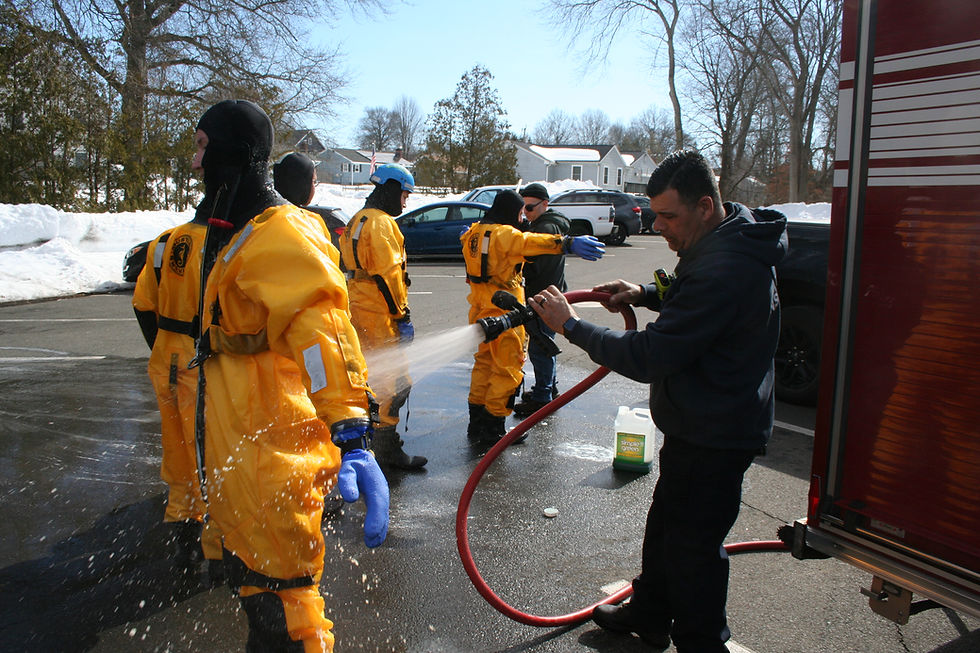
A chilly experience: Firefighters train for cold-water rescues
Updated: Apr 24
by Mark Jahne
Editor
Photos by Mark Jahne
Firefighters train for a wide variety of emergencies and among the most challenging is cold water rescue. This involves frigid water and perhaps ice as well and time is always a factor.
They need to act quickly, efficiently and safely. The Newington Volunteer Fire Department held a special training exercise the morning of Feb. 28 at Mill Pond Park on a day when the ice was more than 15 inches thick.

An augur was used to drill a hole in the middle of the pond and a volunteer in a special thermally lined wet suit went into the hole so that firefighters could practice rescuing someone in such a predicament. Geoff Anderson has volunteered to be the victim for several years and performed the task once again.
Fire Chief Jeffrey Trommer explained why this kind of training is important.
“We have Mill Pond, we have Churchill Park, Piper Brook,” streams, brooks and other bodies of water of various sizes, he said.
NFD is also part of Task Force 5, a five-town collaboration of fire departments, and could be called to assist with a cold-water rescue in another town. Three task force members (Cromwell, Rocky Hill and Wethersfield) border the Connecticut River and sometimes must pull people from its dangerous current.

“Once they fall in it’s a rescue,” Trommer said. “Hypothermia sets in rapidly. Once they fall in, they get stuck.”
Cold-water rescue is defined as any event when the temperature of the water is below 60 degrees. Water in Connecticut’s rivers, ponds, unheated swimming pools and Long Island Sound is below 60 degrees 10 months a year. It only rises above that during the months of July and August.
“We have two people go in the water,” Trommer said.

A specialized boat or sled is used to remove the victim and bring that person back to the shore for medical assessment. Firefighters don’t walk across the ice, the move either on their bellies or on hands and knees to spread out their weight.
If the ice breaks beneath them it complicates matters and puts their safety at risk. They wear special suits to shield them from the cold air and water.
The boat or sled is attached to ropes and staff on shore use these ropes to retrieve the vessel and rescuers once they have the victim out of the water. Other firefighters are ready to assist if there is a problem with bringing the vessel back to dry ground.

NFD has trucks that carry specialized equipment for such events in their cargo bays. The goal is to have every firefighter become familiar with this equipment and the skills and strategies needed to affect a successful rescue.
Deputy Chief Robert Regina said the department trained more than 80 firefighters that day. He expressed the department’s support to the Town Council for providing additional funding to purchase two more wet suits – making a total of six – and a new Oceanid rapid deployment rescue craft.
“We just got it last night,” he said.
Deputy Mayor Kim Radda and Town Councilor Gail Budrejko came to watch it being used for the first time.

“It went very well,” Training Capt. Pedro Machado said. “We have two major ponds and other bodies of water in the woods. You don’t know by looking at it how thick the ice is.”
Also on hand were three representatives of the Tolland County Dive Team. They are specially trained to deal with recovering bodies or evidence from beneath the water.

“We dove through the ice many times. We try to train for ice once a year,” leader Steve Willard said. NL