


Firefighters Learn to Perform Cold-Water Rescues
Training to save lives
by Mark Jahne
Editor
Firefighters don’t just extinguish fires. They provide emergency medical aid, rescue people from burning buildings, extricate people trapped in crashed cars and trucks, and other scenarios, and much more.
Among the most challenging calls they receive are cold water rescues when someone needs to be pulled out of an icy pond, lake or river. Weather conditions add another element of difficulty to the task.

The Rocky Hill Volunteer Fire Department recently held a training class and drill to prepare for such events. It’s important for firefighters to understand how to safely extract people from the water while at the same time not placing themselves at risk and making the situation worse.
An instructor from Mission CIT led the training. He told them that more than 250 people die in the United States every year after falling through ice or into otherwise cold water.
Cold water rescues are defined as those involving water temperatures below 59 degree. Except for July and August, most inland and shoreline water in Connecticut is below that threshold.
It becomes even more challenging in the winter when the water temperature may be close to or below freezing and ice is involved. Those most at risk are children and young adults who may not think about the risks when skating, playing hockey, ice fishing and snowmobile riding.
Ice becomes weak when it starts to melt, the instructor said. Fluctuating weather also affects the strength of ice. It tends to be thinner closer to shore.
Even otherwise strong ice may have weak spots. People should stay off any ice that is less than two inches thick. Anything under four inches is considered dangerous.
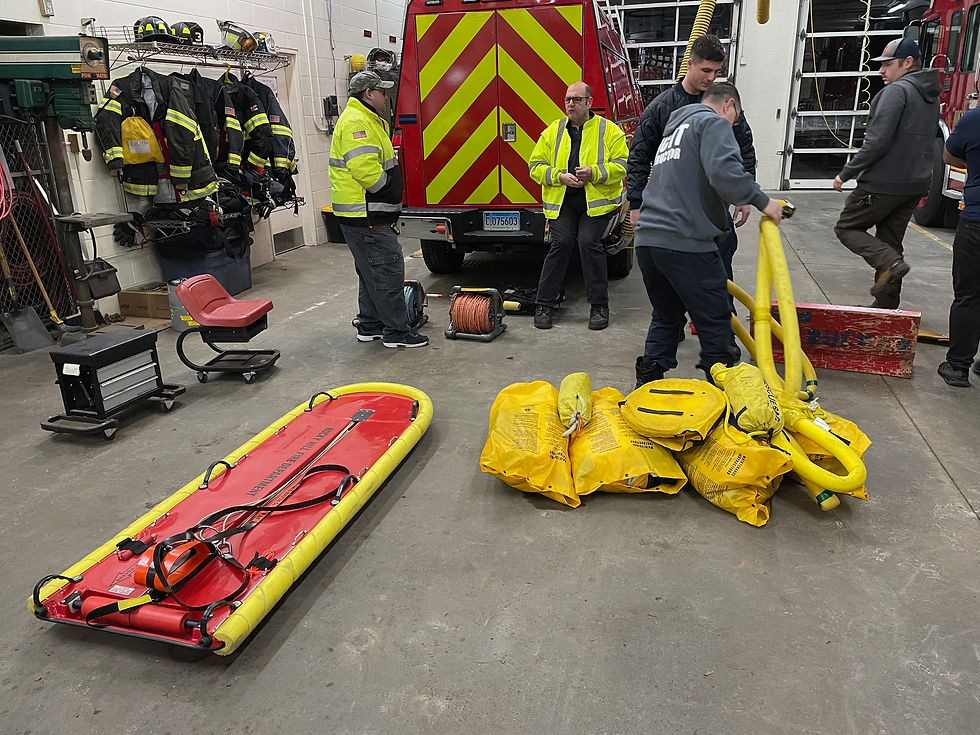
Firefighters learned that they should never undertake a cold water or ice rescue alone. Safety protocols demand at least one more rescuer be on the scene. Everyone needs to be thoroughly familiar with the equipment.
Time is a major factor when it comes to cold water incidents. Hypothermia sets in only 15 minutes after someone falls into 32-degree water.
“We have specialized cold water rescue suits,” Deputy Chief Jeff Gerace said. “We bring rescue sleds. They are always attached to ropes.”
The suits are thermal regulated to keep firefighters warm. When going out on ice firefighters use a redundant double-rope system, he added.
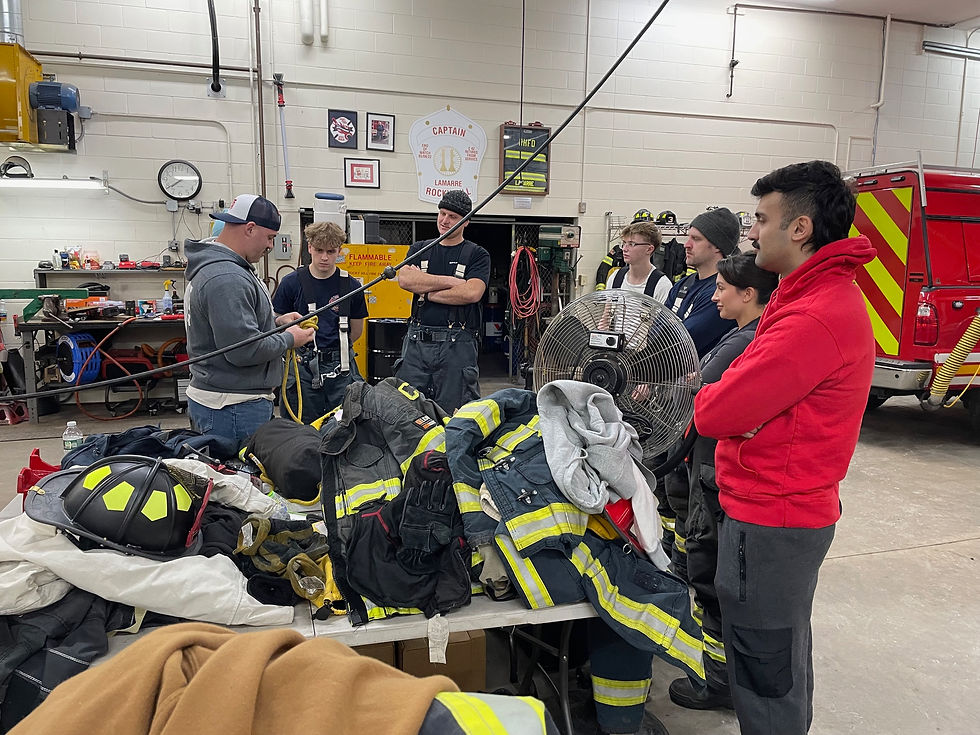
He reiterated that cold water and ice rescues are undertaken as a team with at least two firefighters on shore to provide support and assist if something goes wrong.
The usual staffing is two firefighters on the ice or water, two on the shore and two more backing them up. The first option is to throw a life ring attached to a rope. The victim can grab the ring and be pulled to safety.
“We want to get them out of the hazard as quickly as we can,” Gerace said.
If the life ring option is not feasible the next approach is to send firefighters out with an inflatable boat. If the rescue is on ice they don’t walk, they crawl on their bellies to disperse their weight and reduce the risk of the ice giving way beneath them.
“The biggest challenge is weight,” Gerace said.
“We used two pieces of equipment to make a rescue on the river,” Joe Buechler added.
He is the department’s deputy chief of training. Those two pieces were an inflatable Zodiac boat and ice sled.
“We purchased new sleds that have a pulley system,” he said.
If necessary, firefighters can smash their way through the ice if it’s not too thick. Ponds and lakes are one thing, but the Connecticut River is a much greater challenge because of its powerful currents.
“People can get sucked under,” Gerace said.

“It’s too dangerous to practice on the river but that’s where most of our rescues are,” Buechler said.
Training is conducted on the river during warm weather, Gerace added. There are several new firefighters who need to be trained in how to deal with such emergencies.
Both men said the department gets one or two cold water calls every year, if not more. The victims are usually people but on occasion they will rescue an animal such as a deer.
They also said that when it comes to cold water rescues things tend to happen quickly. It’s a harsh environment in which to work and that’s why training is so important because a delayed or inadequate response could be fatal.
Fire Chief Michael Garrahy agreed and spoke of the success his men and women have had with such incidents.
“Ask the lady we pulled out of the river last year in less than six minutes,” he said. “The guys rose to the occasion. The risk versus reward is great.”
“Those suits went on fast. The equipment was there” and ready to be deployed, Buechler added.