



Hidden History: The Hales - a River Family
by Robert Herron
Town Historian Emeritus
Photos submitted
One of the many interesting things about Rocky Hill is its relationship to the Connecticut River. In addition to our proud seafaring history, we are the home of the Rocky Hill-Glastonbury Ferry, the oldest ferry in America, and for many years had a booming fishing industry. The Hale family has been prominent in all these areas.

The Hale family has long history in Wethersfield, Glastonbury and Rocky Hill. Samuel Hale, the ancestor of the Hale rivermen, was one of the original settlers of Wethersfield in 1634 and later one of the first settlers of Glastonbury in 1690. The Hale family prospered on both sides of the river. This treatment deals with the Hales of Rocky Hill.
This family has deep roots in Rocky Hill. Wilbur Hudson Hale fought in the Civil War. He also served as interim captain of the ferry when Capt. Frank Smith became ill with pneumonia. Wilbur and Ella Hale were the parents of several prominent sons including Arthur Hudson Hale, Raymond Francis Hale and Henry Aspeth Hale.
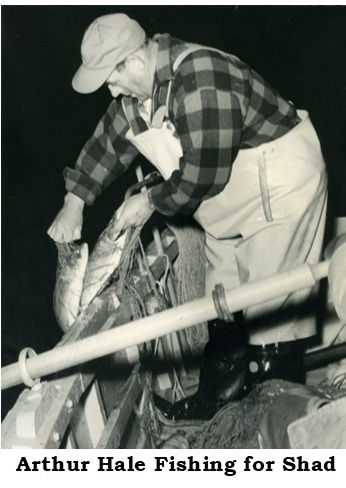
Arthur was a veteran of the Spanish-American War and was an active river man and a fisherman on the river. Raymond was a World War I veteran. He was the first person from town called up for the July 1917 draft and was discharged from the Army at Camp Meade, Md., in July 1918 for medical reasons.
Raymond was a fisherman working for Elwood F. Belden, a prominent Rocky Hill businessman and the husband of Cora Belden for whom the library building was named in 1917 and had worked at the Connecticut Foundry for most of his life. He died in 1969.
Henry Hale, the son of Wilbur Hale, was a long-time commercial fisherman on the Connecticut River and became the next captain on the ferry. He retired in 1962 and his son Arthur took over as captain until 1973.
Henry, a longtime commercial shad fisherman on the river, became the next captain of the ferry. He held that position for 23 years from 1939 until his retirement in 1962.
World War I veteran George Curtis Green was Wilbur Hale’s grandson. George came from historic stock. He was descended from Thomas Hooker Green who founded the Hartford Courant and Timothy Green, founder of the New London Gazette.
There was one black mark in George’s otherwise admirable genealogy. Wilbur’s daughter Inez Hale married Dr. Samuel Green in 1895 when she was 15 years old. George E. Green was born in 1897. His parents were divorced in April 1899 when Doctor Green was found guilty of intolerable cruelty, intemperance and improper conduct.
According to Hartford Courant articles of the time, he was accused of beating her and it was claimed that he slept with a pistol near his bed that he told her he meant to kill her if she upset him. Witnesses testified that “he was, indeed, habitually intemperate and violent and a shameless womanizer.”
After the divorce was granted, Samuel lost custody of George. George and his mother were taken in and raised by Wilbur and Ella Hale.
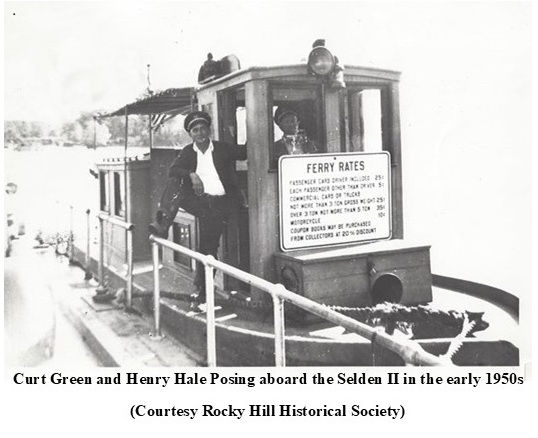
George joined the Navy, becoming the first person in town to enlist after the outbreak of the World War II. He was first mate of the ferry from 1945 until his death in 1955.
The Hale family continued in this tradition of working on the river long after Captain Henry’s retirement. Arthur Sexton Hale, Henry’s son, was described in a 1951 Hartford Courant article as the ferry’s first mate. According to his 1977 obituary he served on the ferry for 26 years, rising to the ranks of captain and senior captain.
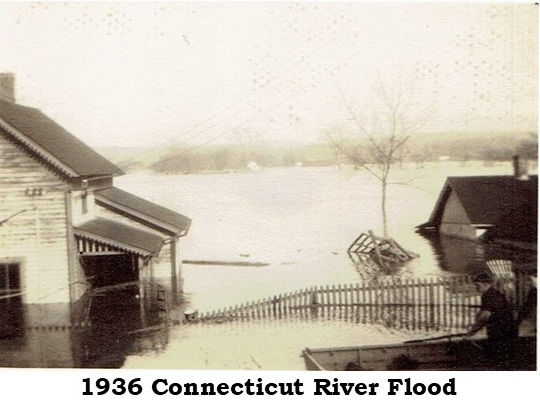
The Hales were involved in many heroic episodes involving the ferry. Dan Taylor was the captain of the ferry during the infamous 1936 flood. Taylor was aboard the ferry barge when it broke free of its moorings and drifted into the river, tethered only by a single cable.
He was stranded on the barge for two days without food or water, exposed to the elements. He was in the early stages of hypothermia when Henry Aspeth Hale, who was a local shad fisherman at the time and who would later serve as the ferry’s captain, and his two sons, Arthur aged 19, and Henry G. aged 16, responded.
They attached an outboard motor to their flat-bottomed fishing boat and with the engine straining and both boys rowing for all they were worth, they were able to rescue Captain Dan. A few days later, when the river settled down, Captain Dan went out with the Selden and retrieved the barge.
In the 21st Century, when one thinks of Rocky Hill one thinks of the ferry, Dinosaur Park, the Quarry, Dividend Park, the Veteran’s Hospital, etc. We often forget that at one time we were quite well known for our shad fishing industry.
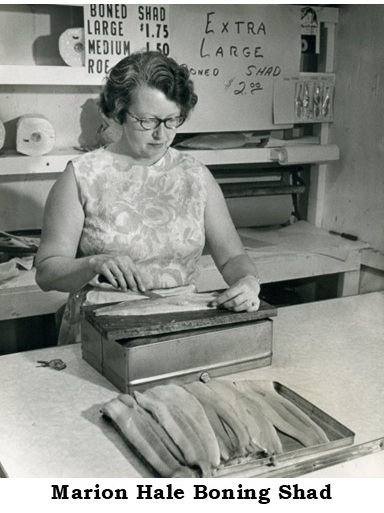
Luminaries from nearby cities and towns such as Mark Twain and Samuel Colt came to town to dine at places like Shipman’s Hotel or the DeRyer Hotel. High-end restaurants like the Honniss Oyster House in Hartford relied on the Hales for their shad supplies.
The ferry landing on the Rocky Hill side was known as Hale’s Landing for many years, although the name seems to have currently gone out of usage. The large white house just south of the landing was the Hale homestead.