



Hidden History: The Sail Loft House
by Robert Herron
Town Historian Emeritus
Submitted photos
How often do we drive by old houses in town and wonder about their history? Drive down Meadow Road towards the ferry landing and you may notice an oddly shaped house on the left as you start down the road. This is the Sail Loft House and it has a fascinating history.
In the 1640s, when it became apparent that the banks of the Connecticut River in Wethersfield were unstable, Wethersfield’s maritime activity moved down the river to Stepney Parish, which later became Rocky Hill.
This involved Rocky Hill developing a ship-building yard, a river port, and a ferry between Rocky Hill and South Glastonbury. The Sail Loft House was built in 1800 and became an important part of this town’s maritime period.
The riverfront was a center of activity with its shipyards, stores, taverns and mills. The Sail Loft House still stands near the ferry landing. In this house of odd lines, sails were fashioned for the ships being built nearby.
The house has two stories in front rising to three stories in the rear. It was constructed so that sails could be hung up as they were being worked upon. There is evidence that the Ropewalk, a long-covered building 600 feet in length, went up the hill to a spot at the rear of 39 Riverview Road although, based on a map in “History of Ancient Wethersfield,” the rope walk may have run north from 39 Riverview Road.

A ropewalk is a long straight narrow lane, or a covered pathway, where long strands of material are twisted into rope. Hemp rope was woven or worn rope was dried and mended upon the return of a ship months later.
Elisha Callendar made sails here circa 1810s. He was also a ferry captain. Several ferrymen have owned this house at various times.
The town’s Methodist church began operations as a small congregation ministered to by a circuit preacher in 1828. Services were held in people’s homes and, for a time, at the Sail Loft House at 276 Meadow Road.

The Sail Loft House, the Rocky Hill Shipyard and the ropewalk abutted one another and formed a maritime area. The coming of the railroad in 1871 changed the street plan and topography of the riverfront.
First, the road that became Pratt Street originally ran east and ended at Meadow Road. The railroad tracks forced the road to turn north and connect at Glastonbury Avenue. Riverview Road, which originally passed north of the Sail Loft House, was redirected and ran to its present location where it connected with Glastonbury Avenue.
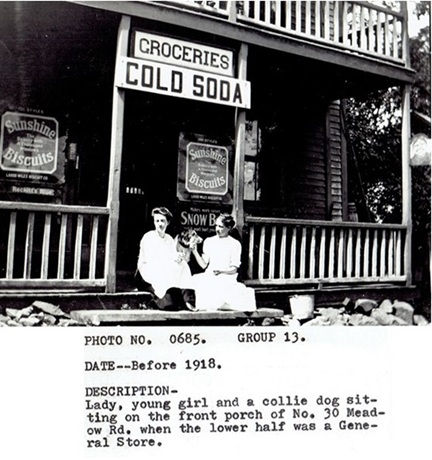
As the town’s maritime era faded, the Sail Loft House evolved into a general store owned by Rodrick Grimes and later by John Ellis.
The turn of the 20th Century was a time of contention for the ferry. Businesspeople in South Glastonbury were dissatisfied with the ferry’s operation and ferry operators felt they were undercompensated.

In January 1902 Leonard Hollister, the owner of the ferry, stated that he didn’t want to build a new ferry and no longer wanted to operate the current one. John Ellis and Elmer E. Brown of Rocky Hill operated the ferry in 1902 and 1903. The South Glastonbury businesspeople relied on the ferry to carry material to and from the Rocky Hill railroad station and continued to be dissatisfied with its operations.
Ellis was something of a local character on the Rocky Hill riverfront. He owned a store at the old Sail Loft House at 276 Meadow Road and owned excursion boats on the river. Ferry customers regularly complained about Ellis operating the ferry at unpredictable hours that didn’t conform to regulations.
The ferry was supposed to run from sunrise until 9 p.m. every day. Ellis regularly shut down for lunch and didn’t run on Sundays. He would shut the ferry down for small problems like a slight fog. In one case, a man arrived at the ferry and was told it was out of service because the engine had been taken apart for service, although the man could see the engine running with smoke coming from the stack.
Ellis routinely refused to go out of his way to accommodate people and in at least one case told a potential customer to “go to Hell.” He argued that his failures to perform were based on safety concerns related to the inadequacy of the steam ferry “Rocky Hill.” He was supported in this claim by at least one other experienced ferryman.
Ellis and his crewman Brown offered to “dispose of their interest” and businesspeople agreed that this was a good solution. The dissatisfaction seems to have centered on Ellis since Brown returned in 1906, 1907 and 1912 to work on the ferry.
The National Register of Historic Places, administered by the U.S. Department of the Interior, recognizes properties of significance to the community, state, or nation. There are three Rocky Hill Historic Districts recognized by the National Register: Elm Street Historic District, Glastonbury-Rocky Hill Ferry Historic District and Rocky Hill Center Historic District.
The Sail Loft House is in the Glastonbury-Rocky Hill Ferry Historic District. According to the National Registry’s website, the Sail Loft House isn’t on the National Registry, although it seems like a prime candidate.
Based on the town leadership’s correct assumption that the town was about to experience a growth spurt, house numbers on several Rocky Hill streets changed in 1960. The street number of the Sail Loft House was changed from 30 to 276. RHL
Do you own one of Rocky Hill’s historic homes? If you are interested in its history, contact the Rocky Hill Historical Society at rhhistory.org.