

The art of wood
Updated: Mar 25
Daniel Bailey’s custom furniture is almost too beautiful to use

By Tracey Weiss
Editor
Daniel Bailey is currently working on a baby cradle for an expecting family. This one-of-a-kind piece, made entirely by hand using Port Orford wood, will likely be passed down through future generations born into the family that commissioned it.
It’s one of hundreds of items that Bailey, who has been creating custom furniture for residential and commercial clients as well as faith organizations for almost 50 years, operates under the name Heartwood Designs. He has two woodworking shops—one in West Hartford, and the other in Avon, at the Farmington Valley Arts Center. “The studio in Avon is really a satellite space,” he said. He’s been there for two years and uses it to showcase the work he has for sale, as well as doing a lot of fine tuning. “I do a lot of hand tooling in that space,” he added.
His space in West Hartford is where pieces are created and designed and the bigger tools are, although the studio space at FVAC is filled with all manner of knives, squares, scrapers, chisels and sharpening tools. All of those items help him produce work that often may have carved designs, sculptural shaping, and other details.
Bailey is one man operation. “Everything I do has been done just by me,” he said. “All of my work has been produced individually. And it’s hard work.”
It’s the kind of work that takes years to develop. The result is museum-quality original work. And it’s satisfying, but not always “pure pleasure” to create some of the pieces. “It’s fussy,” he said. One tool that he uses, for instance, is a Japanese plane that can shave wood to a micron-—a 1000th of a millimeter. “One error or slip of a tool could set the project back a week or two.”
He employs an ancient technique called joinery. Joinery is the skilled craft of connecting pieces of wood to create furniture, cabinets, and structural components like doors, windows, and stairs. “Glue hadn’t been invented yet,” he added. “It’s painstaking work.”
Not every woodworker has the background that Bailey does. He studied math and literature at UConn as an undergraduate.
It was upon meeting a European-trained sculptor and cabinet maker who did reproduction and restoration of museum quality furniture that he developed his love for the work. “I learned carving from him and worked with him in his shop,” he said. He followed up with classes at the Rhode Island School of Design.
He received his MFA from the School for American Craftsmen at the Rochester Institute of Technology, “the oldest school of its kind in the country,” he said. He studied design, and “learned a lot about it;” in fact, so much, that he was teaching design there, too.
He taught college level furniture design and making for a couple years after that in Michigan and New York.
After that, he used his design experience to work as a consulting industrial designer for Fisher Price (for children’s furniture) and Corning Glass (for wood products). He also moved abroad to work in Europe with his wife, Kerry Driscoll, designing furniture in the late 80s/early 90s. “It opened my eyes,” he said. “Although I see myself as having been part of the Western tradition for many decades, I was influenced by Asian furniture beginning in the 80’s, and for the past several years, I’ve learned more about Japanese woodworking,” he said.

Heartwood Designs came out of a desire “to develop my own style, “make stuff to be used, and make it to endure and be a pleasure to have,” he said.
Client and friend David Smith has had a bible box since Dan Bailey made it for him in the 1970s. “It’s held up incredibly well,” and moved with me at least five times. Every time I open it, the (joinery) is still perfectly matched. His work is exceptional. Known him since college. Followed his career as he has gone through all of his training.”
Working on pieces like he does requires using his training in design. In making chairs for offices, he studied seating design. In designing cribs for Fisher Price, he studied Jean Piaget, the renowned Swiss psychologist who pioneered developmental psychology for children with his theory of cognitive development. “I wanted it to be comfortable and peaceful for an infant,” he said.
He admires the work of James Krenov, a Swedish cabinet maker. “He has a distinct approach and is Eastern influenced,” he said. He also loves the work of George Nakashima, a woodworker with a love for trees.
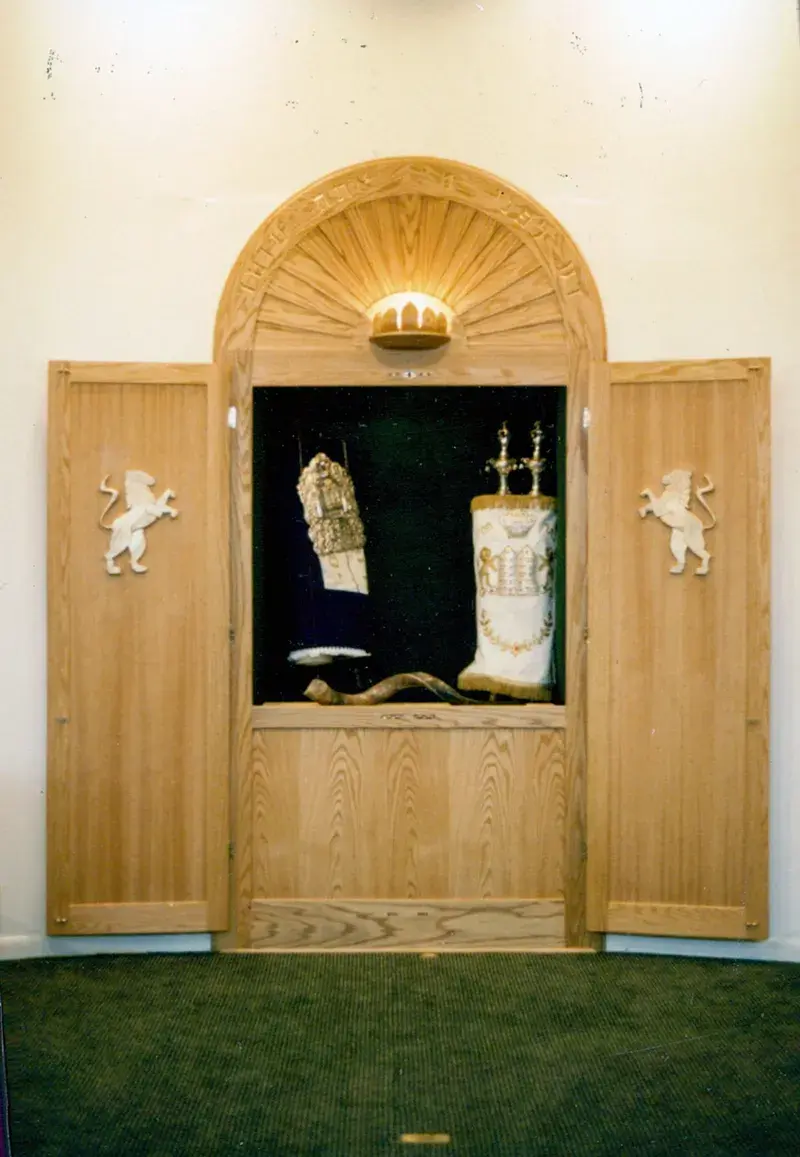
Over the years, Bailey has also sought out grants and commissions for specialty work for medical facilities, churches chapels, synagogues, and more.
“I did a door (with a carved oak entrance door) for The CT Hospice, the first hospice hospital in the country. “I was the first woodworker to have a grant from the Connecticut Commission on the Arts. I made the door,” he said. He was also selected to create the furnishings for the chapel including a carved circular altar, a podium, kneelers, and curved wall cabinets.
Bailey makes small items that pique his interest as well, including cutting boards, jewelry boxes, cabinets and his latest, bonsai tree stands.
“The beauty of the wood is my greatest motivation,” he said. “I love trees and feel that I can give them another life by making them into objects that can last for hundreds of years.”
All his pieces are made with his unique design. “You won’t find anything like it at Ikea,” he said. “You might find something that serves the same purpose, but collectors who invest in handmade items like mine want something special. I never really do the same piece twice.”
Heartwood Designs
860-463-6687