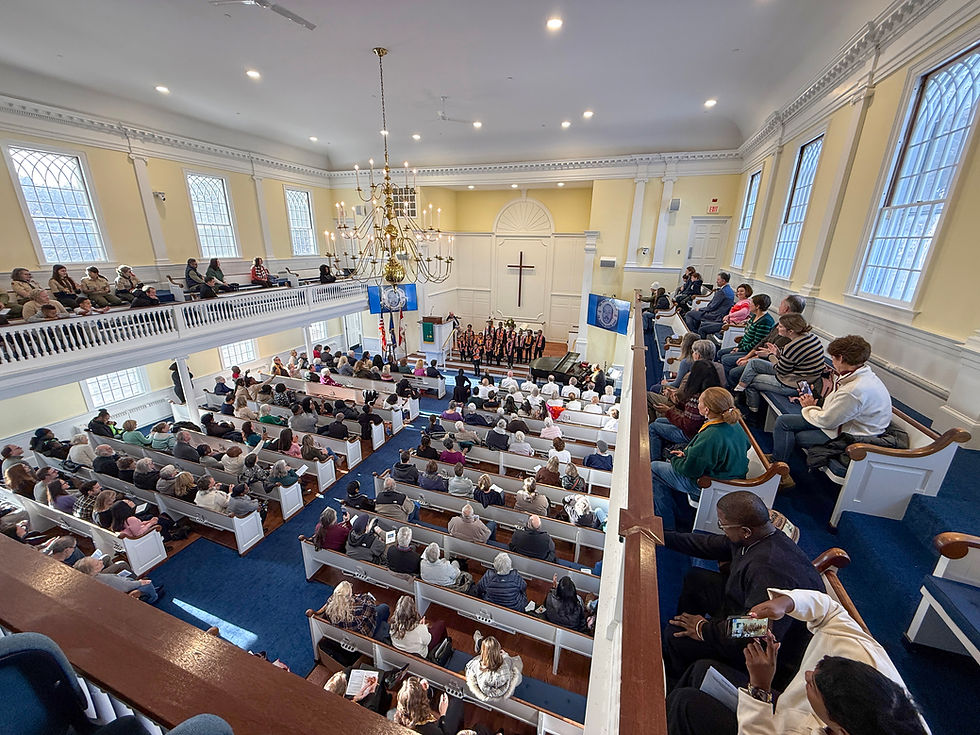


Community gathers for Martin Luther King Day in Simsbury
By John Fitts
Editor
Photos by John Fitts
The annual Community Celebration, held at First Church of Christ, Simsbury for many years, is particularly poignant for local residents as King came to the town is the summers of 1944 and 1947 with his fellow Morehouse College students to work in tobacco fields.

“We gather not only to honor a giant of American history but to remember that greatness is often shaped in quiet places by moments, landscapes, and communities that may not know their influence until years later,” said John Hampton, chair of the MLK in Simsbury Celebration Committee. “Simsbury is one of those places. Long before the world knew Dr. Martin Luther King as a Nobel laureate, a civil rights leader and the conscience of a nation, he was a young man named Michael, who spent formative summers right here in this town. As a teenager and college student he came north from Atlanta to work tobacco in Simsbury.

He labored during the day, but he also thought, read, questioned and listened. These years were years of formation, years when his mind and spirit were still becoming. Dr. King reflected that it was during his time here that he first felt a clear calling for the ministry.
In Simsbury, away from the expectations placed upon him as the son of a prominent preacher, he had space to discern his own purpose. Here he began to understand that faith was not simply something inherited, but something chosen. That realization would shape the course of his life and, in time, the course of our nation. It’s remarkable to think in this town among ordinary days and honest work, the seeds of an extraordinary calling took root.”

Hampton also called on attendees to continue King’s legacy, and the ceremony included inspirational words from the late Civil Rights leader.
Dr. Lalitha Shivaswamy, a member of the Simsbury Board of Finance, read excerpts from “The Drum Major Instinct,” a sermon Dr. Martin Luther King, Jr. delivered at the Ebenezer Baptist Church in Atlanta, Ga. On Feb. 4, 1968. She also shared her own story about coming to this country from India 27 years ago and expressed her gratefulness for all the United States has given her and the opportunities her family has had.

“It is our duty to ensure that absolutely everybody experiences the equality that I did because if even one person does not experience it, there is no equality for anyone,” Shivaswamy said.
Additionally, Dr. Arthur House reads selections from “The Future of Integration,” a speech Dr. King delivered at Oberlin College on Oct. 22, 1964.
Music was also a big part of the day, with selections that ranged from reflective to rousing.
The Simsbury Intonations, the Faith Seventh-Day Adventist Children of Faith, and the Simsbury High School’s Gertrude Banks Gospel Choir and Band all performed. At the end, the entire assembly came together for a rendition of “Lift Every Voice and Sing.”
John Mills, genealogist, historian and founder of the nonprofit Alex Breanne Corporation, was the event’s keynote speaker. His non-profit is known to highlight little known histories of Black families and individuals, and last summer, the organization was instrumental in installing a Simsbury Cemetery memorial honoring Peter and Esther Jackson, a black family from Simsbury whose decedents served in the Revolutionary and Civil Wars.
Mills spend part of his time talking about those who were often just out of the frame in historic video and photos but made a meaningful impact. One example he used was of gospel singer Mahalia Jackson, who offered encouragement to King, including the precursor to a famous moment when she told the Civil Rights Leader to ‘tell ‘em about the dream.’” On another occasion, she calmed King’s nerves with song.

Mills also spoke of personal experiences, the quiet strength of relatives, their struggles and the impact of King’s assassination on his own family. He also shared more about the Simsbury family honored last year.
“Last year, my non-profit completed research into a family here in Simsbury… Peter and Esther Jackson. Peter was brought to Simsbury from Barbados in the mid 1700s, enslaved in this town. Esther’s father, London Wallace, was also enslaved her in Simsbury and served in the French & Indian War. Esther also had three brothers who fought during the Revolutionary War. Finally, Peter and Esther had 7 grandsons who fought during the Civil War, six of them dying while at war, never making it back to Connecticut.
A family steeped in the creation of our nation, five of them buried at Simsbury Cemetery, yet relatively unknown to our nation, nor those in this town. They served from the shadows… without luxury or pretense. They are the personification of Martin Luther King Jr.’s message. They should be revered for their contributions.”
Mills also touched on the origins of the Holiday and the resistance to it, sharing another personal experience.

“In 2001, my company was considering giving employees that day off but also charging us one of our vacation days for it. So, some employees were upset about that. I remember one of my coworkers asking me, ‘Why do Black people need that as a holiday?’ I was so confused by that question. I remember wondering why does he see it as a holiday only for me? Why does he see it as being about color and not about content of character?”
Mills also noted King’s request for a simple funeral procession consisting of a farm wagon and two mules.

“We stand on the shoulders of giants, y’all. We are the shadow cast by that which cannot be seen. But we have their words, we have their model; we even have their imagery, even in death, that provide us moral insight.
The only question that remains – What will you do with that?" VL